
In the €450 to €650 sport helmet segment there are two ways of understanding engineering: HJC's, which in recent years has climbed from volume manufacturer to technological benchmark with the RPHA 12, and Shoei's, which with the NXR2 represents decades of continuous refinement without sudden leaps. We compare their technical arguments side by side to see which one makes more sense for you.
HJC RPHA 12: when circuit technology reaches the street
The RPHA 12 is the result of HJC deciding it wanted to compete with Shoei and Arai on the technical level, not just on price. The key is the PIM EVO (Premium Integrated Matrix Evolution) shell, a mix of carbon-aramid fibre, carbon fibre, glass fibre, organic non-woven fabric and natural linen fibre — an unusual material combination at this price point. That doesn't translate into an especially light helmet, though: in size M it weighs around 1,474 g in the glass-fibre version (Champion Helmets), dropping to about 1,383 g in the Carbon version. In its most common configuration, it's actually a bit heavier than the NXR2, not lighter.
The ventilation system is the Advanced Channeling Ventilation System: four intakes (brow, chin and sides) plus rear extractors under the spoiler, with wings that cut drag and noise when closed. It moves air well at road speed, but in port count it sits behind the NXR2, which runs 6 intakes and 4 extractors.
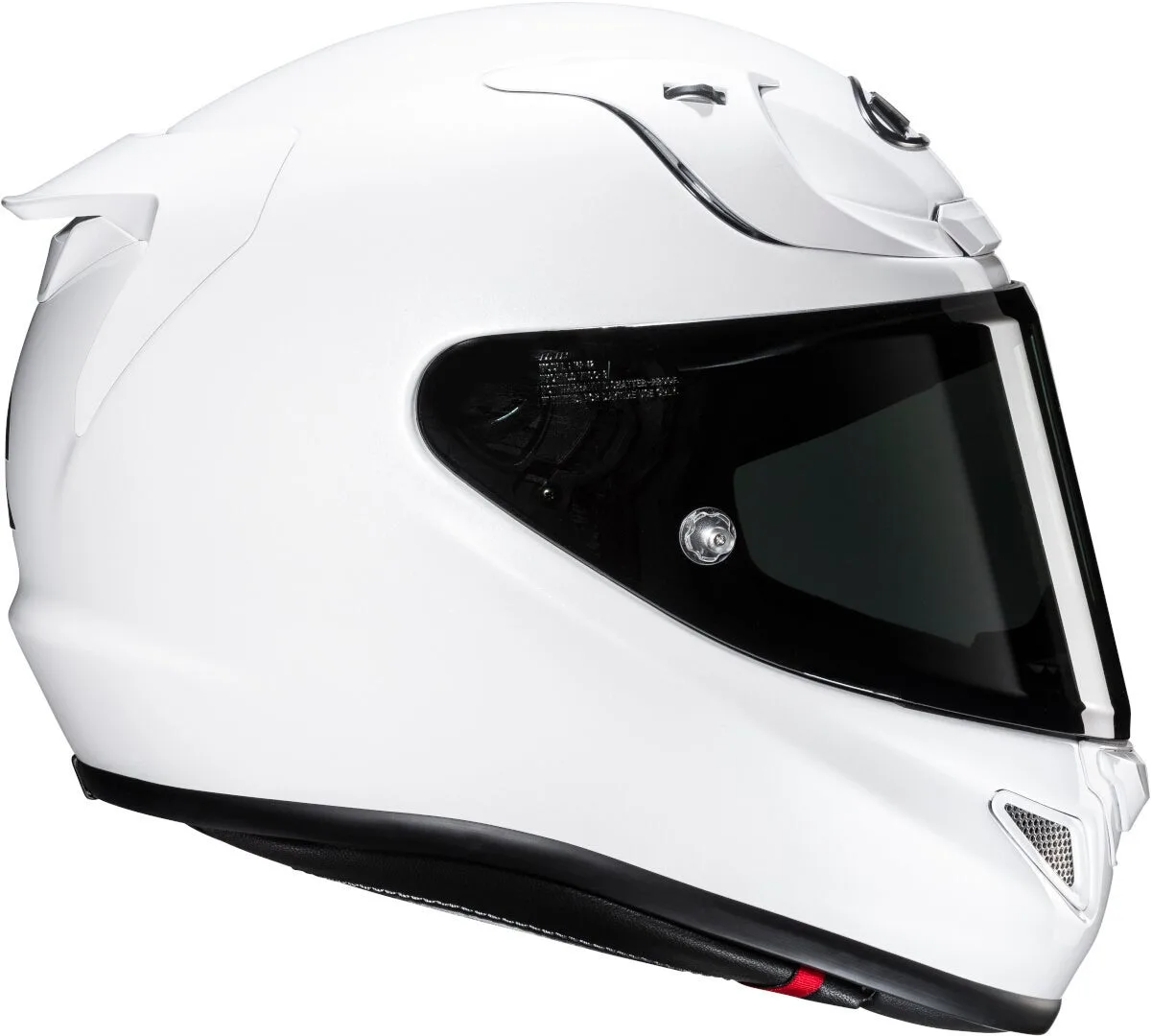
- Shell: PIM EVO (carbon-aramid fibre, carbon fibre, glass fibre, non-woven fabric and linen fibre), 4 shell sizes.
- Weight (M): ~1,474 g (glass-fibre version) / ~1,383 g (Carbon version).
- Ventilation: 4 intakes + rear extractors under the spoiler.
- Visor: HJ-42, curved 2D shape, two-way pivot ratchet system. Pinlock-ready.
- Interior: Removable and washable RPHA Premium Fit fabric, moisture-wicking, emergency-release cheek pads.
- Certification: ECE 22.06.
- RRP: €459.90 in Solid colours; graphics from €499.90 to €649.90 (Quartararo Replica).
What doesn't convince us about the RPHA 12
Weight is its weak point against the NXR2: in the glass-fibre version — the most common one — it's around 80 g heavier than the Shoei, which is noticeable on multi-hour stages. Both helmets use a double D-ring chinstrap, so there's no real difference there; where the gap shows is in the interior fit system, which is more basic than Shoei's. The aerodynamics are excellent in a sport position, but if you ride a naked bike or in a more upright position, the RPHA 12's profile generates a bit more wind pressure at motorway speeds.
Shoei NXR2: the excellence of continuous refinement
The NXR2 doesn't revolutionise anything. It's, deliberately, the polished evolution of a line that already worked well. The AIM+ (Advanced Integrated Matrix Plus) shell is multi-layer composite — six layers of high-performance organic fibres combined with glass fibre, not carbon — and weighs around 1,390 g in size M, actually a touch less than the RPHA 12's glass-fibre version despite skipping carbon.
The 3D Max-Dry interior, with differentiated-density pads, is, without exaggeration, one of the best fit systems in its segment. It lets you adapt the helmet to very different head shapes and ages well over time. A few sessions of use and the NXR2 has already perceptibly taken the shape of your head.
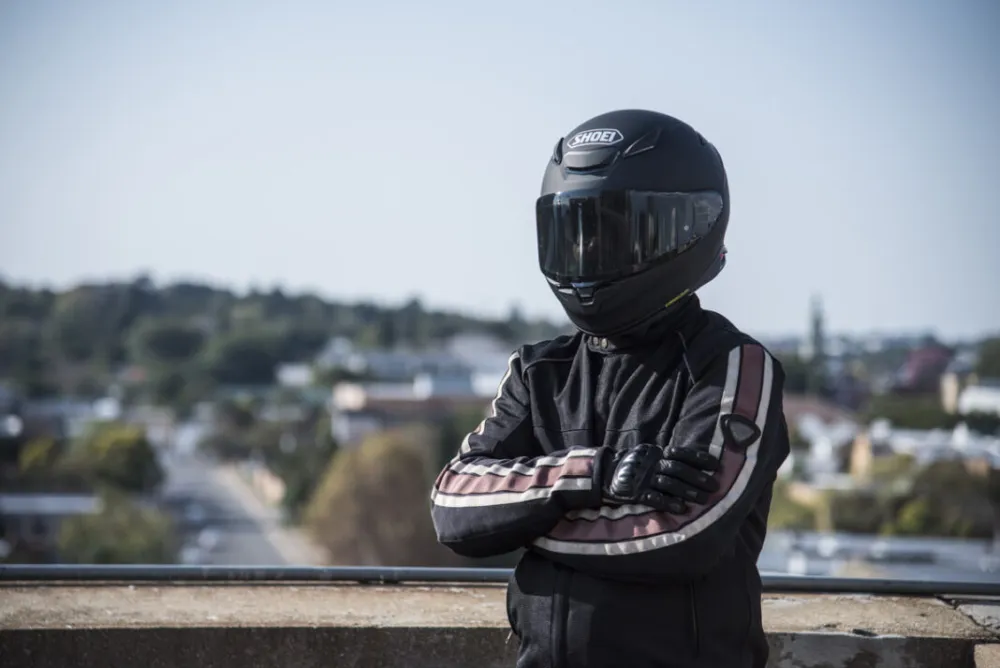
- Shell: AIM+ multi-layer composite (glass fibre + organic fibres), 4 shell sizes.
- Weight (M): ~1,390 g.
- Ventilation: 6 intakes (brow and chin) + 4 rear extractors. Quiet.
- Visor: CWR-F2, flat 2D shape that doesn't distort the field of view, with a central locking mechanism and a lever adjustment for a better seal. Includes Pinlock EVO 120.
- Interior: Removable 3D Max-Dry, ergonomic pads by density.
- Certification: ECE 22.06.
- RRP: €479 in white and black, €499 in other solid colours, €599 with graphics (Shoei Spain).
What doesn't convince us about the NXR2
The central visor-locking mechanism requires an adaptation period — it's much safer against impacts, but with thick winter gloves it's a bit harder to operate at first. Original replacement visors (photochromic or smoked) carry a high price tag. And despite winning on intake count, HJC's chin-vent mechanism is a touch quicker to operate with gloves on.
Direct comparison: the points that matter
- Weight and neck fatigue on long trips: NXR2 wins. At ~1,390 g versus the RPHA 12's ~1,474 g (glass-fibre version), the Shoei is the lighter of the two in its usual configuration; only the RPHA 12 Carbon (~1,383 g) closes the gap.
- Interior comfort and head fit: NXR2 wins. The density-graded 3D Max-Dry interior fits better and ages more gracefully.
- Summer ventilation: NXR2 wins on port count (6+4 versus the RPHA 12's 4), though the HJC's wide chin vent keeps it from falling far behind.
- Noise level on the motorway: NXR2 wins. Shoei's AIM+ shell and wind-tunnel work cut turbulence; the RPHA 12 generates more noise on a naked or upright bike.
- Field of view: Technical draw. Shoei's CWR-F2 is flat and very wide; HJC's HJ-42 isn't far behind on peripheral vision.
- Entry price: RPHA 12 wins, but only just: €459.90 versus €479 for the cheapest NXR2. With graphics they are level (€599 for the NXR2, €499.90–649.90 for the RPHA 12).
- Materials and "tech" perception: RPHA 12 wins on perception. Carbon-aramid fibre as standard at this price is a strong marketing argument, even if it doesn't translate into less weight in practice.
Who is each one for?
The RPHA 12 is the right helmet if you want the lowest entry price in the segment, like the idea of a carbon-fibre shell, or ride in a tucked-in sport position where its aerodynamics shine.
The NXR2 is the right helmet if weight and motorway silence are your priority, you have a hard-to-fit head, or you simply want the more well-rounded package even if it costs a bit more upfront.
Verdict
There's a clearer winner here than it first looked. The NXR2 (9.5/10) is lighter, quieter, better fitting and better ventilated — it wins on almost every objective category. The RPHA 12 (8.5/10) is still a very solid option, especially if budget is the deciding factor: its entry versions are cheaper and its carbon-fibre look has no rival at that price, but it isn't the lightest or best-ventilated helmet in this match-up, despite what HJC's marketing implies.
If performance and comfort matter more than price: NXR2. If you want the best price-to-image ratio from a genuinely competent helmet: RPHA 12.


