

Spain's Royal Decree 518/2026 has been in force since October 1, 2026. It amends the General Traffic Regulations (Reglamento General de Circulación) to better protect vulnerable road users. Plenty of headlines are mixing things up: "open-face helmets banned", "your 22.05 helmet is no longer valid", "you need homologated gloves from October". We went straight to the official text in the BOE and the DGT's announcement. Here's what it actually says.
The short version
- Motorcycles: if you already wear a helmet homologated under UN Regulation R22 (22.05 or 22.06), nothing changes for you.
- Mopeds: helmets that are only "certified" rather than homologated are on their way out, but there's one year of grace, until October 1, 2027.
- Gloves: mandatory on interurban roads, for rider and passenger, with a €200 fine. The motorcycle gloves you already use are valid.
- Closed footwear: mandatory on every type of road for riders and passengers of motorcycles and mopeds. It's a serious offence with a €200 fine.
- Reflective vest: motorcycles must carry one. Professional riders of motorcycles and mopeds must wear one while riding; other motorcyclists must wear it when standing on the carriageway or hard shoulder of an interurban road.
- Open-face (jet) helmets: not banned. The text doesn't mention helmet type at all.
Riding in Spain from abroad
These rules apply to everyone riding on Spanish roads, including visitors on their own bike or a rented one. Before you set off, check four things:
- Helmet: it must carry an R22 homologation label (22.05 or 22.06). A helmet with only a US DOT or Snell sticker doesn't meet the rule. See how to check the label.
- Gloves: required for rider and passenger outside towns and cities (interurban roads). Any proper motorcycle gloves are fine for now.
- Footwear: closed shoes or boots on every road, in town too. No sandals or flip-flops.
- Hard shoulder: riding on it is only allowed on stretches signposted for it, with traffic stopped, at up to 30 km/h. As of October 5, 2026 no stretch has been signposted yet, and Catalonia won't enable any. Riding on it anywhere else is a €200 fine.
Is my ECE 22.05 helmet still legal?
Yes. The new wording of article 118 requires riders of motorcycles and mopeds to wear "cascos de protección homologados conforme al Reglamento UNECE R22, adecuadamente abrochados, cuando circulen en todo tipo de vías": protective helmets homologated under UNECE Regulation R22, properly fastened, on every type of road. ECE 22.05 and ECE 22.06 are both series of that same R22 regulation, and the decree doesn't distinguish between them. A 22.05 helmet in good condition, with its label intact and properly fastened, stays legal. Nothing in the text forces you to replace it on October 1.
Being legal doesn't mean it's the safest option, though. 22.06 adds rotational impact tests and tests at more points on the shell. If you're buying a new helmet, it'll be 22.06 anyway, and there are good ones at every price point. See our best modular helmets under €200.
Are open-face (jet) helmets banned?
No. That's the most widespread myth. The decree requires a helmet homologated under R22. It doesn't say full-face, and it doesn't restrict any type. A jet helmet homologated under R22 (a "J" on the label) remains perfectly legal, in town and on interurban roads.
What actually changes for mopeds
This is the real change for helmets. Until now, moped riders could use helmets that were only certified. Under the decree they need a homologated helmet, the same as motorcyclists, but with a year to adapt. Transitional provision one reads: "Los conductores y pasajeros de ciclomotores podrán seguir utilizando cascos de protección certificados durante el plazo de un año desde la fecha de entrada en vigor de este real decreto". In other words, moped riders and passengers can keep using certified helmets for one year from the date the decree comes into force. So that requirement applies from October 1, 2027. The DGT also dates the homologated helmet requirement to that day.
How to check your helmet in 30 seconds
Look at the label sewn onto the chin strap:
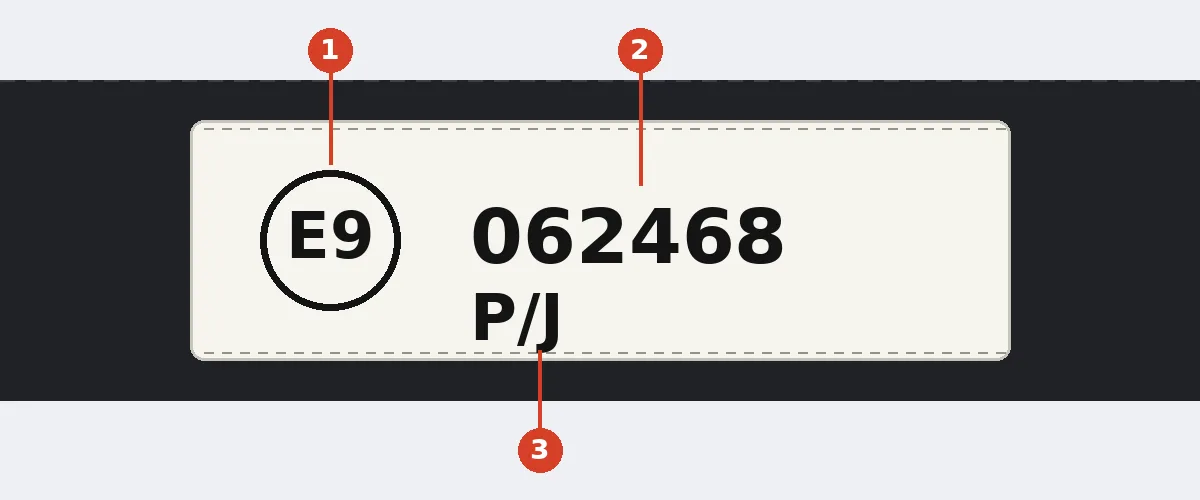
- (1) A capital "E" inside a circle followed by a number (the country that granted the homologation, e.g. E9 is Spain, E3 Italy, E1 Germany).
- (2) An approval number starting with 05 or 06, which tells you whether it's 22.05 or 22.06.
- (3) The protection type: P (full-face), J (open-face) or P/J (modular homologated for both uses).
If there's no label, or it's illegible, the helmet can't prove its homologation. The same applies if it only carries a US certification (DOT or Snell), which doesn't replace European R22 homologation.
Gloves: mandatory on interurban roads
Article 118 adds protective gloves for motorcycle and moped riders and passengers "cuando circulen por vías interurbanas", meaning on interurban roads. The DGT classes riding without them as a serious offence with a €200 fine. What's still pending is the ministerial order that will set the technical specifications of homologated gloves. Until it comes into force, transitional provision two sets the rule: "se utilizarán guantes de protección de las mismas características que los que se usan en la actualidad". In other words, the protective gloves riders use today are valid. The DGT confirmed this in its September 24, 2026 note.
You don't need to buy new gloves if you already ride with proper motorcycle gloves. If you're buying, look for gloves certified under EN 13594, the European standard for motorcycle gloves. Whatever the order ends up requiring, they're what actually protects your hands in a fall. Some options: the Alpinestars GP Pro R3 for sport riding, or our Gore-Tex vs heated winter gloves comparison.
Closed footwear on every road
Riders and passengers of motorcycles and mopeds must wear closed footwear on every type of road. The text doesn't require motorcycle boots, but flip-flops and sandals are out. If you're looking for a proper boot, see our Alpinestars SMX-6 V3 review.
Reflective vest: required equipment for motorcycles
The decree adds a high-visibility reflective vest meeting personal protective equipment requirements to the mandatory equipment of motorcycles. It does not extend that onboard-equipment provision to mopeds. When the rider must wear the vest depends on the situation:
- Professional riders (delivery couriers and anyone whose job is riding a motorcycle or moped) must wear the vest at all times while riding, with no exception for time of day or visibility.
- Other motorcycle riders must put it on when they get off the bike and stand on the carriageway or hard shoulder of an interurban road. Commuting on your own motorcycle does not in itself make riding your professional activity.
Other changes for motorcyclists
- Passengers: the minimum age for a passenger on a motorcycle or moped is 12. The decree includes a limited exception for children over 7.
- Hard shoulder in traffic jams: motorcycles may use the right-hand hard shoulder on specifically authorised stretches, only when traffic is stopped by congestion, in single file and at no more than 30 km/h. Not in Catalonia: the Servei Català de Trànsit, which manages traffic there, will not enable any stretches and keeps fining motorcycles that ride on the hard shoulder. Elsewhere, no stretch is enabled yet: as of October 5, 2026, neither the DGT nor any regional government has published a list of authorised stretches, so in practice there is still nowhere to use it.
FAQ
Do I have to buy a new helmet?
Not if you ride a motorcycle and your helmet is homologated under R22 (22.05 or 22.06) and in good condition. Moped riders with a helmet that's only certified have until October 1, 2027.
Is a US DOT helmet legal in Spain?
Not on its own. Spanish rules require a helmet homologated under UN Regulation R22 (ECE 22.05 or 22.06). DOT and Snell are US certifications and don't replace it. Some helmets carry both: if yours also has the circled "E" label on the chin strap, it's valid.
Can I be fined for riding without gloves?
On interurban roads, yes (€200). In town gloves aren't mandatory. We'll update this article when the order defining homologated gloves is published.
Do I have to wear the reflective vest just for commuting to work by motorcycle?
No. Commuting to work does not in itself make riding your professional activity. Motorcycle riders must carry the vest as part of the vehicle's equipment and wear it if they stand on the carriageway or hard shoulder of an interurban road. Riders who use a motorcycle or moped for their work must wear it while riding.
Is a modular helmet legal with the chin bar up?
Only if it's homologated as P/J (for both uses). If the label only shows P, it's homologated to be ridden closed.
Can I ride on the hard shoulder in traffic jams in Catalonia?
No. The new rule lets motorcycles use the hard shoulder only on stretches that are expressly authorised, and the Servei Català de Trànsit has said it will not authorise any. Its director, Ramon Lamiel, argues that the hard shoulder must stay free for emergencies and broken-down vehicles. The rest of the changes (gloves, closed footwear and reflective vest) do apply in Catalonia.
Sources: Royal Decree 518/2026 (BOE), the DGT press release of June 23, the DGT note of September 24 and the DGT update of September 30, 2026. This article is informational and doesn't replace the official text.


